This Is How Art Comes Alive in Bhutan’s Festival Heartbeat
Thimphu, the capital of Bhutan, isn’t your typical city break. I went not for landmarks, but for color, rhythm, and soul. During the Thimphu Tsechu, I witnessed masked dances that felt ancient and alive, temples bursting with intricate murals, and prayer flags fluttering like open-air canvases. Art here isn’t hung in galleries—it’s lived, danced, and breathed. If you’ve ever wondered where tradition is the art, this is your sign.
Arrival in Thimphu: A Capital Like No Other
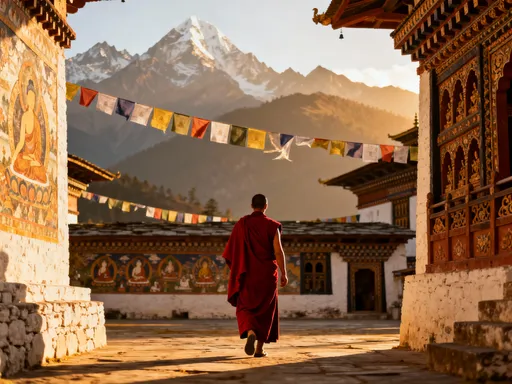
Descending into Paro Airport and driving toward Thimphu, the journey itself sets the tone for what makes this Himalayan kingdom extraordinary. Nestled at 2,300 meters above sea level, Thimphu rests in a deep valley carved by the Wang Chhu River, surrounded by forested peaks that seem to rise like protective hands. The city skyline is notably free of towering skyscrapers or neon signs—instead, traditional architecture dominates, with whitewashed walls, sloping wooden roofs, and prayer wheels spinning gently at intersections. One of the most striking first impressions is the absence of traffic lights. In a world where urban centers race to keep pace with automation, Thimphu chooses a human rhythm. Policemen in crisp uniforms direct traffic with graceful hand gestures, a small but powerful symbol of how Bhutan balances progress with cultural preservation.
Modern government buildings stand shoulder to shoulder with chortens—Buddhist stupas adorned with mantras and prayer flags—and family-run craft shops selling handwoven textiles and wooden bowls. There’s no jarring clash between old and new; rather, there’s a quiet harmony. The city breathes at a deliberate pace, shaped by the rhythms of prayer and seasonal festivals. Monks in maroon and saffron robes walk past office workers with laptops, and the scent of juniper incense drifts from temples into bustling weekend markets. This seamless blend isn’t accidental. It reflects Bhutan’s national philosophy of Gross National Happiness, which prioritizes cultural integrity, environmental conservation, and spiritual well-being over unchecked economic growth. In Thimphu, aesthetics are never separated from ethics. Beauty is not for display alone—it serves a higher purpose.
The spiritual hum of the city is palpable. Even on ordinary days, the air carries a sense of reverence. Prayer wheels line the sidewalks, their soft metallic clicks echoing with every turn. Locals pause in their daily routines to spin them, sending mantras into the wind. Monasteries perch on hilltops, visible from nearly every corner of the city, their golden roofs catching the morning sun. This atmosphere shapes how art is perceived and experienced. It is not confined to museums or exhibitions. Instead, art exists in motion—in the flutter of a flag, the pattern of a woven kira (traditional dress), or the precise brushstroke of a thangka painter. Arrival in Thimphu is not just a geographic transition; it’s a shift in consciousness. Visitors begin to see that here, art is not something separate from life. It is life.
The Living Canvas: Art Beyond Galleries
In most parts of the world, art is something you visit—a painting in a museum, a sculpture in a plaza. But in Thimphu, art is woven into the fabric of daily existence. It doesn’t wait to be observed; it unfolds naturally, embedded in rituals, architecture, and craftsmanship. Bhutanese art is not created for aesthetic pleasure alone. It is a sacred language, a means of transmitting Buddhist teachings, moral values, and cosmological beliefs across generations. Every color, symbol, and form carries meaning. A lotus flower represents purity; a dragon signifies power and protection; the endless knot stands for interconnectedness and eternity. These are not mere decorations—they are visual scriptures.
One of the most revered art forms is the thangka, a detailed scroll painting typically depicting deities, mandalas, or scenes from Buddhist mythology. These are not mass-produced souvenirs but devotional objects, often commissioned for temples or personal meditation. Creating a single thangka can take weeks or even months, requiring mastery of mineral pigments, precise proportions, and deep spiritual understanding. Artists follow strict iconographic rules passed down through centuries. Even the preparation of the canvas—stretching cotton on a wooden frame, applying a mixture of glue and chalk—is a meditative process. The artist begins each day with prayers, recognizing that the work is not their own creation but a vessel for sacred energy.
Beyond thangkas, Bhutanese art thrives in wood carving, metalwork, and dzong architecture. The grand fortress-monasteries known as dzongs are masterpieces of engineering and design. Their massive walls, towering assembly halls, and intricately carved windows reflect both defensive necessity and spiritual symbolism. Every beam and bracket is adorned with motifs of deities, animals, and floral patterns, each chosen for its protective or auspicious meaning. In local studios around Thimphu, artisans continue these traditions with quiet dedication. A woodcarver might spend days chiseling a single window frame, his hands moving with the precision of a surgeon. These artists are not seeking fame or fortune. They see themselves as custodians of a legacy, ensuring that the visual language of Bhutan remains unbroken.
Thimphu Tsechu: When the Entire City Becomes a Stage
The Thimphu Tsechu, held annually in the autumn, is not just a festival—it is the heartbeat of the city’s cultural life. Spanning several days, it draws thousands of locals and visitors to the Tashichho Dzong courtyard, transforming the space into a living theater of devotion and artistry. The word tsechu means “tenth day,” commemorating the birth of Guru Rinpoche, the saint who brought Buddhism to Bhutan in the 8th century. While deeply religious, the festival is also a grand celebration of Bhutanese identity, where dance, music, and costume converge into a powerful artistic expression.
At the center of the celebration are the Cham dances, performed by monks and trained laymen in elaborate masks and brocade robes. These are not entertainment pieces but sacred rituals meant to purify negative energies and convey moral lessons. Each mask represents a specific deity, demon, or historical figure. The Black Hat dancers, for instance, embody enlightened protectors who vanquish ignorance and evil. Their slow, deliberate movements—each step synchronized with drumbeats and cymbals—are believed to generate spiritual merit. The costumes themselves are works of art: hand-embroidered silk, ornate headdresses, and long silk aprons that sway with every turn. Watching the dances, one senses that the performers are not merely acting—they are becoming vessels for ancient forces.
The storytelling is nonverbal but profoundly clear. A dance might depict the triumph of good over evil, the cycle of rebirth, or the subjugation of a malevolent spirit. The audience, seated on the grass or perched on stone walls, watches in reverent silence. Children sit wide-eyed, absorbing the myths that shape their worldview. For many Bhutanese, attending the Tsechu is a lifelong practice, a way of renewing faith and community bonds. The festival is also a rare moment when sacred art becomes accessible. While thangkas and temple murals are often kept behind closed doors, the Cham dances are performed in public, inviting all to witness and participate in the spiritual narrative. In this way, the Tsechu ensures that art remains a shared inheritance, not a secluded relic.
Inside the Dzongs: Fortress of Culture and Creativity
No structure in Bhutan embodies the fusion of art, religion, and governance more completely than the dzong. Tashichho Dzong, Thimphu’s most iconic building, serves as both the seat of government and a major monastic center. Its imposing whitewashed walls rise against the mountain backdrop, crowned with golden roofs that shimmer in the sunlight. Built in the 17th century and expanded over time, the dzong is a masterpiece of Bhutanese architecture, where form follows function and symbolism. Its layout reflects the mandala—a sacred geometric pattern representing the universe—guiding visitors through a journey from the outer world to inner sanctity.
Inside, the walls are alive with murals that tell stories of Buddhist sages, celestial beings, and moral parables. These paintings are not mere decorations but teaching tools, designed to inspire reflection and devotion. The artists use natural pigments—lapis lazuli for blue, malachite for green, gold leaf for divine radiance—applying them with meticulous care. Perspective in Bhutanese art is symbolic rather than realistic: important figures are larger, landscapes are flattened, and time is layered within a single frame. A single mural might show a saint’s birth, enlightenment, and teachings all at once, inviting the viewer to see beyond linear time.
The craftsmanship extends beyond the walls. Door frames are carved with protective deities, window lattices feature intricate floral patterns, and temple roofs are adorned with golden dragons and phoenixes, their eyes inlaid with glass to ward off evil. Even the floors are significant—polished wood in administrative halls, stone in ceremonial spaces. During the Tsechu, the dzong transforms. The central courtyard, usually quiet, becomes a stage for the Cham dances. Monks unfurl giant thangkas on the outer walls, their vibrant colors visible for miles. The air fills with the scent of butter lamps and the sound of long horns. This seasonal shift underscores a key truth: in Bhutan, art is not static. It breathes with the calendar, responding to ritual and community need. The dzong is not a monument frozen in time—it is a living organism, pulsing with cultural energy.
Craftsmen and Custodians: Meeting the Makers
Behind every piece of Bhutanese art is a story of dedication, discipline, and传承 (传承 means transmission, but in context, it refers to the passing down of knowledge). In a small weaving center on the outskirts of Thimphu, a group of women sit at traditional looms, their hands moving with practiced ease. They are creating kiras, the elegant ankle-length dresses worn by Bhutanese women. Each kira is a tapestry of meaning—stripes in specific colors denote regional identity; geometric patterns may represent mountains, rivers, or spiritual concepts. The process is slow and exacting. A single kira can take weeks to complete, with threads dyed using natural pigments from roots, bark, and minerals.
One weaver explains that the patterns are not chosen randomly. Some designs are reserved for special occasions; others are passed down within families. The craft is taught from mother to daughter, ensuring that regional styles survive. In another workshop, a mask maker shapes a wooden face with delicate chisels. The masks used in Cham dances are not ordinary props—they are consecrated objects, believed to house spiritual energy during performance. The maker follows strict guidelines: the eyes must be perfectly aligned, the expression balanced between wrath and compassion. Certain materials, like specific types of wood or pigments, are required for authenticity and ritual efficacy. He speaks quietly, with reverence, emphasizing that he does not “create” the mask but helps bring it into being according to tradition.
Apprenticeships remain the primary way these skills are preserved. Young artists train for years under master craftsmen, learning not just technique but philosophy. At the National Institute for Zorig Chusum, students spend eight years mastering one of the 13 traditional arts, from painting to sculpture to embroidery. There is no rush to produce. Mastery is measured in patience, precision, and spiritual readiness. These artisans are not celebrities, yet they hold immense cultural value. They are the quiet guardians of Bhutan’s visual language, ensuring that every stroke, thread, and carving continues to carry meaning. Meeting them is a humbling reminder that art, at its best, is not about innovation for its own sake—but about continuity, respect, and service to something greater.
Festival as Full-Sensory Art Installation
The Thimphu Tsechu is best understood not as a series of performances but as a total work of art—an immersive, multi-sensory experience that engages sight, sound, smell, and emotion. From the moment one enters the dzong courtyard, the senses are awakened. The visual spectacle is overwhelming: monks in crimson robes, dancers in peacock-feathered headdresses, children in their finest kiras and ghos (traditional garments), and the ever-present prayer flags forming a canopy of color above. The flags, inscribed with mantras, flutter in the wind, believed to spread blessings with every movement. The ground is covered in fine gravel, raked into perfect patterns, adding to the sense of sacred order.
The soundscape is equally powerful. Long horns called dungchen echo across the valley, their deep tones resonating in the chest. Cymbals clash in rhythmic patterns, drums pulse like a heartbeat, and monks chant in low, resonant voices. The music is not background noise—it is an integral part of the ritual, designed to induce a meditative state and invoke divine presence. Even the silence between dances carries weight. When the performers remove their masks, there is a palpable shift, as if the spiritual energy recedes, leaving behind a sense of awe.
Smell plays a subtle but vital role. The sweet, smoky scent of burning juniper purifies the air. Butter lamps flicker in the temples, their ghee fragrance mingling with the earthy aroma of roasted barley, served as tsampa to visitors. These sensory layers do not compete—they harmonize, creating an atmosphere that feels both celebratory and sacred. For attendees, especially older women who have come from villages across the country, the Tsechu is a homecoming. They sit wrapped in thick shawls, faces lined with years of mountain sun, eyes glistening during certain dances. Their presence reminds us that this art is not for tourists. It is for them—for their ancestors, their children, their souls. The festival is not a show. It is a collective act of remembrance, healing, and hope.
Beyond the Festival: Keeping the Art Alive Year-Round
While the Tsechu is the most visible expression of Bhutanese art, its roots run deep throughout the year. The National Institute for Zorig Chusum, located just outside Thimphu, is the formal guardian of the country’s artistic heritage. Here, students dedicate eight years to mastering one of the 13 traditional crafts, known collectively as Zorig Chusum. These include thangka painting, wood carving, metal casting, embroidery, and papermaking. Admission is selective, and training is rigorous, combining technical skill with spiritual discipline. Graduates often go on to work in temples, government restoration projects, or family workshops, ensuring that the traditions remain alive.
Tourism plays a complex but generally positive role in sustaining these arts. Visitors who purchase handwoven textiles, thangkas, or wooden crafts directly support local artisans. Many shops in Thimphu are run by cooperatives or family businesses, with prices that reflect fair wages rather than mass-market exploitation. Ethical tourism initiatives encourage travelers to visit studios, participate in short weaving or painting workshops, and learn about the meaning behind the art. This deeper engagement fosters respect and understanding, moving beyond souvenir shopping to meaningful cultural exchange.
At the same time, Bhutan remains vigilant against commercialization. Sacred objects like consecrated masks or ritual thangkas are not sold to tourists. The government enforces strict building codes to preserve traditional architecture, even in new constructions. Schools teach traditional arts alongside modern subjects, ensuring that younger generations grow up with pride in their heritage. For travelers, the best way to engage is with mindfulness. Observing without intrusion, asking permission before photographing performers, and purchasing from reputable sources are small acts that contribute to preservation. The art of Bhutan does not need to be loud or flashy to be powerful. Its strength lies in its authenticity, its continuity, and its purpose.
Thimphu’s art isn’t something you just see—it’s something you feel in your bones. The festivals aren’t performances; they’re acts of devotion painted in motion. In a world chasing novelty, Bhutan offers depth: art that’s not made for applause, but for awakening. To visit Thimphu during Tsechu is to witness culture as a living masterpiece—one that doesn’t end when the music stops, but continues in every prayer, thread, and stroke.